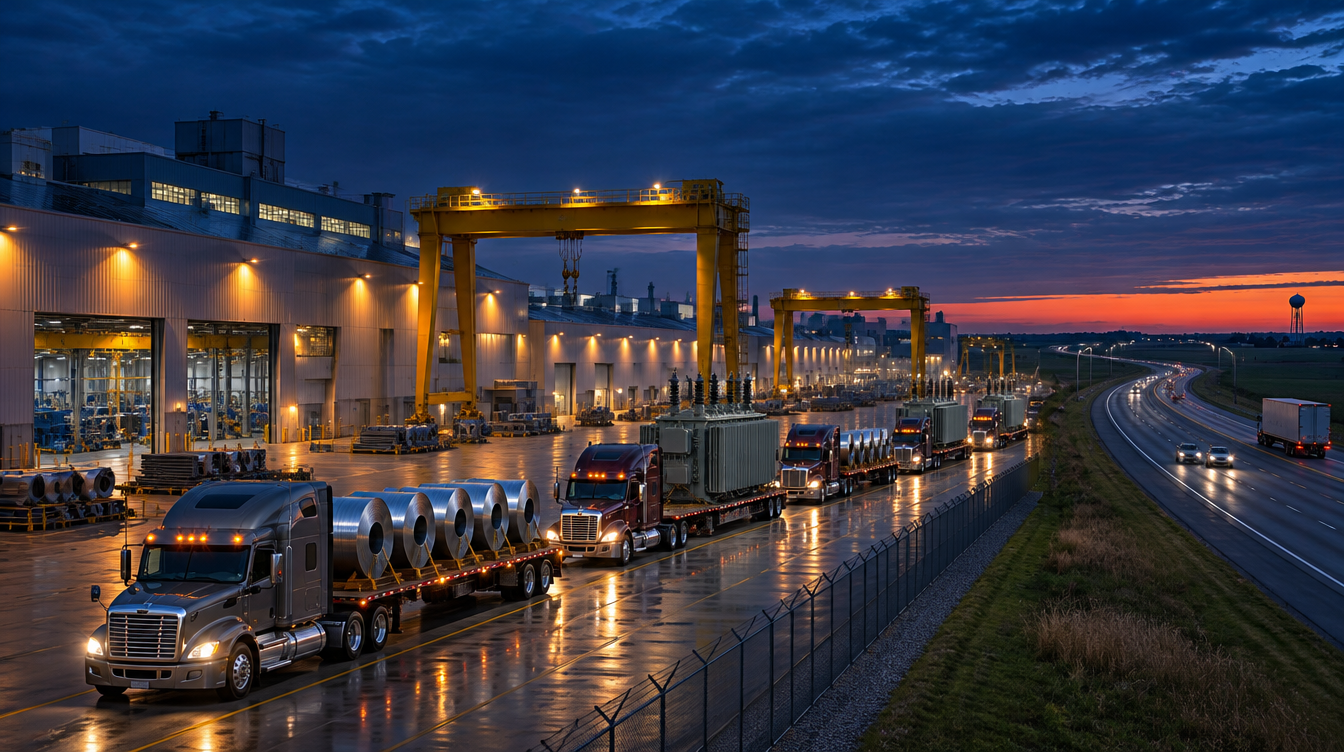
Freight data shows America is making things again. Tariffs, record defense spending and the AI build-out are pulling manufacturing home, and allied defense companies are building plants here. Here is why it matters for defense.
By Ken Tapp, a director of Complete Defense Solutions
Economists like to argue about forecasts. Freight doesn’t argue. It either moves or it doesn’t, and the price of moving it tells you how badly someone needs it moved.
That is why recent comments from Craig Fuller, founder of the freight-data platform FreightWaves, caught our attention. For decades, U.S. freight activity heated up first at the coastal ports, where imported goods arrive, and then rippled inland. Today the hottest freight markets sit in the middle of the country, along the old Rust Belt and down through Texas, and flatbed trucks, which haul steel, lumber and heavy equipment rather than consumer goods, are in such demand that a large share of loads are being turned away.
The pattern points to one conclusion: America is moving raw materials into factories and finished goods out of them. In other words, it is making things again. For the defense industry, that shift is arriving at exactly the right moment.
Policy Is Pulling Production Home
Two forces are working together.
The first is tariffs. When importing a finished product carries a steep tariff, building it inside the United States becomes the more attractive option, especially for products a company expects to sell to the U.S. government for years to come.
The second is a deliberate effort to make domestic investment easier. In March 2025, the President established the U.S. Investment Accelerator within the Department of Commerce, an office created to speed investments of more than $1 billion through federal permitting and regulatory processes. Commerce says the Accelerator plays a central role in carrying out more than $1 trillion in commitments from key trading partners, including $550 billion from Japan, $350 billion from South Korea and $250 billion from Taiwan, aimed at semiconductors, energy, critical minerals and other strategic sectors.
The tariff is the push. The Accelerator is the pull.
The results show up in the project pipeline. One industry tracker counts more than $2 trillion in announced U.S. manufacturing investment as of November 2026, from chip fabs and power equipment plants to munitions lines and the suppliers that feed them.
Defense Demand Has Never Been Clearer
On the demand side, the Department of War’s fiscal 2027 budget request is the largest the United States has ever proposed, at about $1.5 trillion, and calls for nearly tripling missile procurement. It includes $53.6 billion for drone dominance, $65.8 billion for shipbuilding, the largest inflation-adjusted shipbuilding budget since 1962, and a substantial increase in munitions procurement aimed at expanding industry production capacity.
The Department is also changing how it invests. In January 2026, it announced its first direct-to-supplier equity partnership, a $1 billion convertible preferred investment in L3Harris’ Missile Solutions business. The goal is to more than triple solid rocket motor production capacity by 2030, adding roughly one million square feet of production space across facilities in Camden, Arkansas; Huntsville, Alabama; and Orange, Virginia.
When the government itself takes an equity stake to expand a production line, the message to industry is unmistakable: build capacity here, and the demand will be waiting.
Allies Are Building on American Soil
Foreign defense companies are hearing that message.
In September 2026, South Korea’s Hanwha Defense USA announced a $2.2 billion manufacturing campus at the U.S. Army’s Pine Bluff Arsenal in Arkansas. The plant would produce propellant charges and base bleed units for 155mm artillery and could create close to 400 jobs. The investment grew from about $1.3 billion when the Army first announced the project in January, and the company expects construction to finish in 2030, with operations beginning the following year.
The Army has described the arrangement, which pairs underused military land with private capital, as a model it could repeat at other installations.
Sweden’s Saab offers a second example. The company has built autonomous and undersea systems production in Cranston, Rhode Island, and a munitions facility in Grayling, Michigan, for final assembly of shoulder-fired munitions and precision fire systems, a project Michigan’s governor said would create 70 jobs.
Germany is represented as well. In July 2026, Helsing selected West Virginia for its first U.S. drone factory, and American Rheinmetall has announced new strategic investments across its U.S. operations.
American primes are expanding at the same time. In May 2026, Lockheed Martin broke ground on a new Munitions Production Center in Troy, Alabama, to accelerate production of THAAD interceptors.
These companies could build anywhere. They are choosing to build here, close to their largest customer and inside the tariff wall.
AI Is the Other Big Customer
Defense is not the only buyer filling those flatbeds.
Amazon, Microsoft, Alphabet and Meta are on track to spend more than $720 billion in 2026 on data centers and other capital projects, roughly three times what they spent two years earlier. Every dollar of that eventually becomes a purchase order for physical goods.
Consider transformers. Wood Mackenzie projects that U.S. data center electrical equipment will grow from a $20 billion market to $65 billion by 2030, and that demand for padmount transformers in the hyperscale segment alone will climb from about 1,573 units in 2025 to more than 9,000 by 2030. Lead times for critical electrical equipment already run 18 to 36 months.
Consider fiber optic cable. AI-focused data centers need roughly 36 times more fiber than traditional server racks, and lead times have stretched to as long as a year for smaller buyers. Nvidia has invested $300 million in Corning to build three new fiber plants in North Carolina and Texas.
The result is a feedback loop. AI data centers order steel, copper, concrete, cable and transformers from American factories. Those factories, in turn, increasingly rely on AI for design, simulation, robotics and quality control. And both depend on reliable power.
The Energy Advantage
That brings the story back to energy, the theme that ties this series together.
As Fuller has pointed out, energy is one of the largest costs in heavy manufacturing, and the United States enjoys abundant, comparatively inexpensive natural gas. Germany offers the cautionary tale: once an industrial powerhouse, its manufacturing base has struggled after the country retired major energy sources.
For a foreign defense company deciding where to build its next plant, stable and affordable energy can matter as much as labor costs. It is also why the ideas we explored earlier in this series, data centers that bring their own power today and the longer-term promise of fusion, matter to manufacturing as much as to computing.
The Workforce Question
There is one more ingredient: people.
The Department of War’s top industrial base official told Congress in September 2026 that roughly 400,000 skilled-trade positions are unfilled across the defense industrial base. The construction industry, meanwhile, needs about 349,000 new workers this year, according to Associated Builders and Contractors. Every new plant and data center will compete for the same welders, electricians and pipe fitters.
That challenge is also an enormous opportunity for American workers, and it is the subject of the next article in this series.
Where Complete Defense Solutions and AI Arsenals Fit
Complete Defense Solutions, a subsidiary of Complete Financial Solutions, Inc. (OTC: CFSU), focuses on identifying strong defense companies to acquire, companies with proven products, real customers and room to grow.
Through its partnership with AI Arsenals, CDS aims to help those companies establish and scale manufacturing in the United States. AI Arsenals owns a defense manufacturing facility in Parachute, Colorado, and is working toward providing the AI compute capacity that modern manufacturing increasingly depends on.
Our view is simple. Tariffs are pushing production home. The Department of War is creating durable demand. Commerce is clearing the path. AI is turning factories into customers and customers into factories. The companies positioned to build here, power up here and compute here stand to benefit most.
Americans are about to get a lot richer. The factories now taking shape are where much of that wealth will be made.
Sources
- U.S. Department of Commerce, Investment Accelerator commitments — commerce.gov
- The White House, Fact Sheet establishing the U.S. Investment Accelerator (March 2025) — whitehouse.gov
- Digital Citizen, TSMC raises its US investment commitment to $265 billion — digitalcitizen.life
- Industrial Sage, US Manufacturing Investment Tracker — industrialsage.com
- Department of War, FY2027 Budget Request overview — comptroller.war.gov
- Axios, What's inside Trump's $1.5 trillion Pentagon blueprint — axios.com
- Breaking Defense, The Pentagon wants a 188 percent bump for missile procurement — breakingdefense.com
- Greenberg Traurig, Understanding the President's FY2027 Budget Request for the Department of War — gtlaw.com
- Defence Industry Europe, U.S. National Defense Strategy calls for supercharging America's defense industrial base — defence-industry.eu
- SatNews, Department of Defense to Take $1 Billion Equity Stake in L3Harris Missile Solutions — satnews.com
- Defence Industries, L3Harris Closes $1B Investment from Department of War — defence-industries.com
- Manufacturing Dive, Hanwha Defense plans $2.2B manufacturing campus at Pine Bluff Arsenal — manufacturingdive.com
- Manufacturing Today, Hanwha Defense USA expands US manufacturing with $2.2 billion project — manufacturing-today.com
- Saab, new munitions facility in Grayling, Michigan — saab.com
- Defence Blog, Saab to build new munitions facility in Michigan — defence-blog.com
- The Defense Post, Helsing US drone factory — thedefensepost.com
- Rheinmetall, Strategic investments by American Rheinmetall — rheinmetall.com
- Lockheed Martin, New Facility to Support America's Arsenal of Freedom, Accelerated Production of THAAD Interceptors — lockheedmartin.com
- Tech Insider, Big Tech data center spending passes $720 billion in 2026 — tech-insider.org
- Neoteo, US data center construction hit a record annual pace in August — neoteo.com
- Invezz, citing Wood Mackenzie, US data center electrical equipment market to reach $65B by 2030 — invezz.com
- Tom's Hardware, AI data centers are consuming fiber optic cable faster than suppliers can make it — tomshardware.com
- Department of the Air Force / Pentagon News, Rebuilding Defense Industrial Base Requires Skilled Labor — afpc.af.mil
- Construction Executive, citing Associated Builders and Contractors, Workforce Crunch Ahead — constructionexec.com
Forward-looking statements: This article contains forward-looking statements regarding Complete Financial Solutions, Inc.'s and Complete Defense Solutions' acquisition strategy, AI Arsenals' planned AI compute capacity and manufacturing operations, and broader trends in U.S. defense manufacturing, tariffs, data center construction and energy. These statements involve risks and uncertainties, and actual results may differ materially. No acquisition, investment, project or financing is assured.
Important Information:
This article is published for general informational purposes only. It is not an offer to sell or a solicitation of an offer to buy any securities of CFSU, Complete Defense Solutions, Inc. ("CDS"), Ai Arsenals, Inc. ("Ai Arsenals") or any other company, and nothing in it is investment, legal, accounting or tax advice.