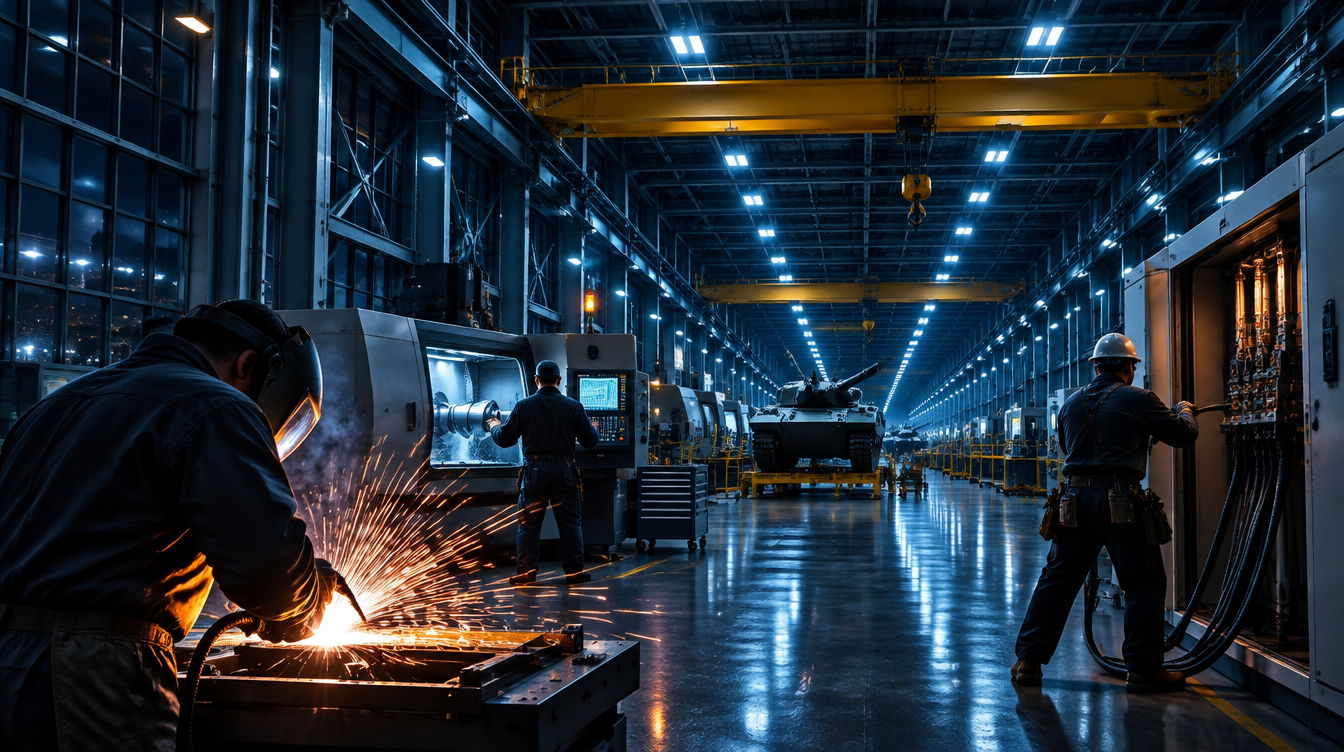
A dollar cannot weld a seam or wire a switchgear room. With 400,000 skilled-trade jobs open in the defense industrial base and data centers competing for the same workers, here is who will build America's comeback, and why their pay is rising.
By Ken Tapp, a director of Complete Defense Solutions
There is a tendency to talk about America’s industrial revival in dollars: trillion-dollar investment pledges, record defense budgets, hundreds of billions in data center spending. Those numbers are real. But a dollar cannot weld a seam, wire a switchgear room or calibrate a machine tool. People do that work, and right now there are not nearly enough of them.
That gap may be the single biggest constraint on the build-out we have described in this series. It may also be one of the biggest economic opportunities of the decade for American workers.
A Shortage Measured in the Hundreds of Thousands
In September 2026, Michael Cadenazzi, the Assistant Secretary of War for Industrial Base Policy, told a House Appropriations defense subcommittee that roughly 400,000 skilled-trade jobs are unfilled across the defense industrial base. He warned that the number could reach 2.5 million over the next decade. His focus, he told lawmakers, was on the engineers, pipe fitters and welders who build the equipment America’s warfighters depend on.
The Department is treating this as a readiness issue, not just a labor statistic. It launched Build Freedom, a national hiring, training and awareness campaign that brings more than 70 workforce projects under one banner, and it awarded a $10 million grant that Cadenazzi said will fund more than 9,000 scholarships. The campaign’s partner, Mike Rowe’s mikeroweWORKS Foundation, has argued that these defense jobs, building ships and weapons systems, are some of the most important trade openings in the country.
Construction tells a similar story. Associated Builders and Contractors estimates the industry must attract about 349,000 net new workers in 2026 and about 456,000 in 2027, largely because experienced workers are retiring. Roughly one in five electricians is over 55.
Where the Pressure Shows Up
The gap is not abstract. It shows up on production lines.
After Russia’s 2022 invasion of Ukraine, the Army set out to raise 155mm artillery shell output from about 14,000 rounds a month to 100,000. According to a July 2026 report from the Department of War’s Inspector General, production had reached about 36,000 rounds a month as of March 2026, nearly triple the starting point but well short of the goal. The limiting factor was the manufacture of projectile metal parts, exactly the kind of skilled machining and forging work the industry is struggling to staff.
Data centers add to the competition. In a 2026 survey by the Associated General Contractors of America, 58% of firms that had worked on data center projects in the past year said those projects increased competition for skilled workers. Each of those sites needs electricians for high-voltage power, HVAC technicians for cooling, and plumbers and pipe fitters for water systems.
The military’s own construction draws on the same pool of workers. The Army is carrying out a 15-year, roughly $16 billion modernization of its arsenals, depots and ammunition plants, many of which date to World War II. The Navy’s plan to modernize its four public shipyards was first estimated in 2018 at about $21 billion over 20 years. The Government Accountability Office now says it could cost about $200 billion and take roughly 50 years.
The Bureau of Labor Statistics projects about 72,700 openings for electricians every year through 2035, along with about 42,000 a year for plumbers and pipefitters and about 40,600 for HVAC mechanics. Most of those openings come from workers retiring or leaving the trade, which means the pipeline has to refill just to stand still.
Wages Are Following Demand
When demand outruns supply, pay rises. Staffing firm Randstad, analyzing more than 150 million U.S. job postings between 2022 and 2026, found that demand for electricians, welders and construction specialists grew by an average of about 30%, while demand for HVAC engineers rose nearly 78% and robotics technicians more than doubled. Randstad’s chief executive has said U.S. skilled-trade wages rose roughly 30% over four years.
Randstad also found a troubling imbalance: for every 100 young workers entering the trades, 102 are leaving. That is why employers, unions and the Department of War are all investing in apprenticeships.
Those apprenticeships are one of the strongest parts of the story. Most electricians learn the trade through a four- or five-year program that includes about 2,000 hours a year of paid on-the-job training. Workers earn while they learn, and they finish without student debt.
The pay reflects the demand. Electrical power-line installers and repairers earned a median of $95,320 in May 2025, according to the Bureau of Labor Statistics. Private industry is stepping in too: Google has funded electrician training with the International Brotherhood of Electrical Workers to help meet the power needs of AI.
The Ripple Effect in the Heartland
In our previous article, we followed freight data into the middle of the country, where flatbed trucks are hauling steel and equipment from the Rust Belt down through Texas. Many of the new jobs are landing in those same places.
Hanwha’s planned $2.2 billion munitions campus at the Pine Bluff Arsenal in Arkansas could create close to 400 jobs. Saab’s munitions facility in Grayling, Michigan, is expected to create about 70. Arkansas officials say the Hanwha plant is one of four capital projects totaling $6 billion planned for Jefferson County over the next three to five years.
Each of those paychecks circulates. Workers buy homes, eat at local restaurants and send their children to local schools. Local businesses hire to keep up, and the tax base grows. For communities that watched factories leave for decades, that is what an industrial revival actually looks like.
Where Complete Defense Solutions and AI Arsenals Fit
Complete Defense Solutions, a subsidiary of Complete Financial Solutions, Inc. (OTC: CFSU), focuses on acquiring strong defense companies and helping them grow in the United States. We recognize that a factory is only as productive as the people inside it, so recruiting, training and retaining skilled workers is part of how we evaluate and support every company we work with.
AI has a role here too. Through its partnership with AI Arsenals, which owns a defense manufacturing facility in Parachute, Colorado, and is working toward providing AI compute capacity for manufacturers, CDS sees AI as a tool that can help train new workers faster, help experienced workers do more and keep quality high as production scales. AI does not replace the welder. It can make that welder more productive and more valuable.
Power, Production and People
This series began with power: AI data centers that must now bring their own electricity, and the longer-term promise of fusion. It continued with production: tariffs, record defense spending and the AI build-out pulling manufacturing back to the United States.
It ends with people. The power plants, factories and data centers now taking shape will be built by hand, by electricians, welders, machinists and pipe fitters, many of them in the middle of the country. When power, production and people all move together, one idea looks less like a prediction and more like a description: Americans are about to get a lot richer.
Sources
- Department of the Air Force / Pentagon News, Rebuilding Defense Industrial Base Requires Skilled Labor — afpc.af.mil
- Defense One, Defense Business Brief: AI manufacturing; Skilled trades — defenseone.com
- The Defense Watch, U.S. Defense Industrial Base Faces 400,000 Skilled Worker Gap — thedefensewatch.com
- Moneywise, Mike Rowe on 400,000 open defense jobs — moneywise.com
- Construction Executive, citing Associated Builders and Contractors, Workforce Crunch Ahead — constructionexec.com
- El Cronista, citing ABC, The U.S. Will Need 349,000 More Construction Workers in 2026 — cronista.com
- Associated General Contractors of America, Construction Workforce Shortages Remain Acute Despite Soft Market Conditions; Data Centers Strain — agc.org
- Defense News, Manufacturing woes hamper US 155mm ammo production — defensenews.com
- Breaking Defense, Army Materiel Command setting conditions ahead of 15-year, $16B facility modernization push — breakingdefense.com
- USNI News, Navy Plans to Spend $21B Over 20 Years to Optimize, Modernize Public Shipyards — news.usni.org
- Breaking Defense, Navy's shipyard revamp could cost more than $200 billion: GAO — breakingdefense.com
- U.S. Bureau of Labor Statistics, Occupational Outlook Handbook: Electricians — bls.gov
- U.S. Bureau of Labor Statistics, Occupational Outlook Handbook: Line Installers and Repairers — bls.gov
- Apollo Technical, skilled trades statistics citing BLS Employment Projections 2025–35 — apollotechnical.com
- Staffing Industry Analysts, citing Randstad USA, Skilled trades roles now take longer to hire than desk-based workers — staffingindustry.com
- Randstad, AI can't build data centers: global demand for skilled trades soars — randstad.com
- IBEW, Google Funding Means More Jobs, Training for IBEW Members — ibew.org
- Supply Chain 24/7, Hanwha Picks Arkansas Arsenal for $2.2 Billion Munitions Plant — supplychain247.com
- Arkansas Advocate via News From The States, Hanwha $2.2 billion factory at Pine Bluff Arsenal — newsfromthestates.com
- Defence Blog, Saab to build new munitions facility in Michigan — defence-blog.com
Forward-looking statements: This article contains forward-looking statements regarding Complete Financial Solutions, Inc.'s and Complete Defense Solutions' acquisition strategy and workforce plans, AI Arsenals' planned AI compute capacity and manufacturing operations, and broader trends in U.S. skilled-trade employment, wages and defense manufacturing. These statements involve risks and uncertainties, and actual results may differ materially. No acquisition, investment, project or financing is assured.
Important Information:
This article is published for general informational purposes only. It is not an offer to sell or a solicitation of an offer to buy any securities of CFSU, Complete Defense Solutions, Inc. ("CDS"), Ai Arsenals, Inc. ("Ai Arsenals") or any other company, and nothing in it is investment, legal, accounting or tax advice.