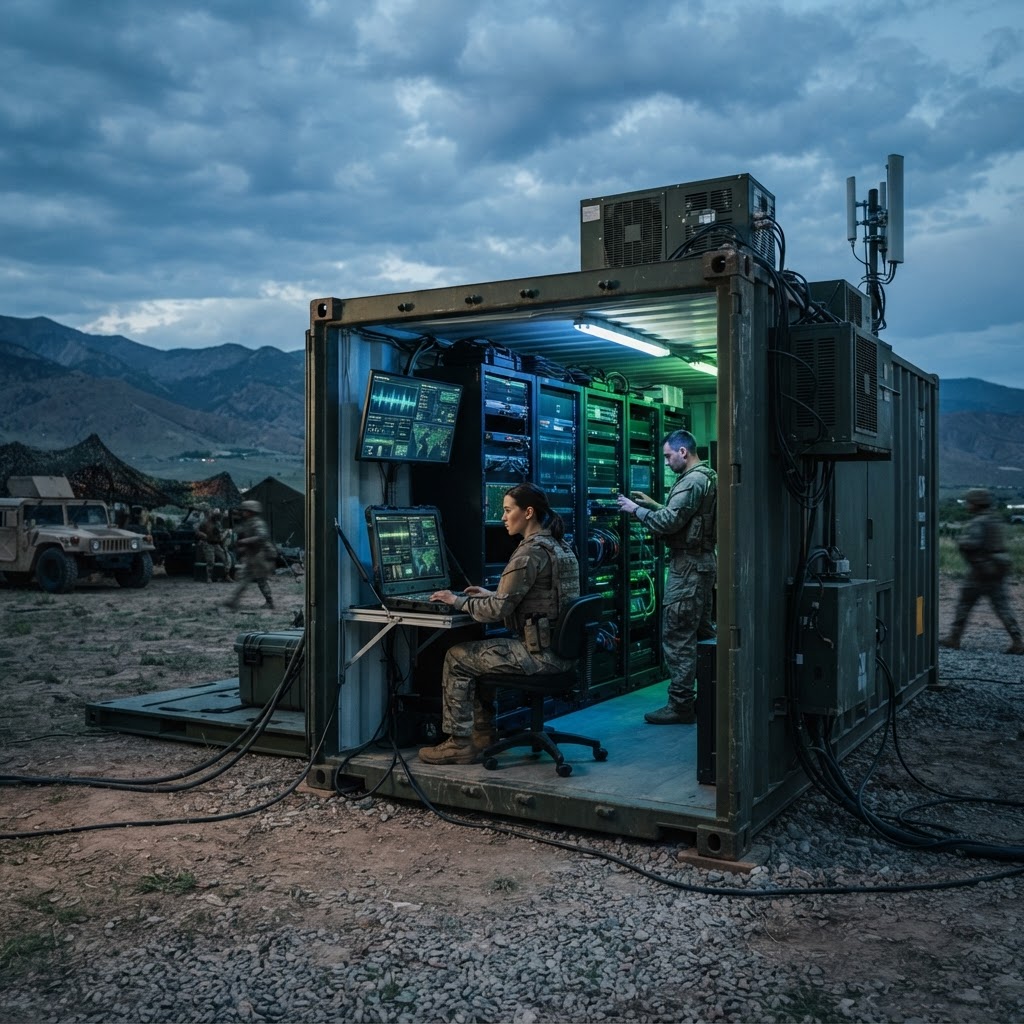
Not every defense mission happens near a data center. AI Arsenals plans modular, containerized secured AI compute that can go where the mission goes: bases, ships and National Guard units.
Most discussion of AI infrastructure pictures enormous data centers. But many defense missions happen far from any data center: on a remote base, aboard a ship or wherever a National Guard unit is called during an emergency. In those places, compute has to be close to the mission.
The Department of War is pushing AI to the edge
The Department of War has made this a clear priority. In January 2026, the War Department launched its Artificial Intelligence Acceleration Strategy, which it says will extend the lead in military AI deployment and establish the United States as the world's undisputed AI-enabled fighting force. According to the department, the strategy is driving a major expansion of AI compute infrastructure through targeted investments.
As law firm Holland & Knight summarized it, the strategy memo mandates substantial expansion of AI compute infrastructure from data centers to tactical, remote or "edge" military environments.
The services are already moving. Warrior Maven has reported on the Army surging small, mobile AI-enabled servers to the tactical edge, and industry experts note that even graphics processors used to run AI can now operate in tactical edge environments, letting mission-critical workloads run directly in the hands of warfighters.
Bringing compute to the mission
AI Arsenals, a portfolio company and strategic partner of Complete Defense Solutions, plans to support that mission with modular, containerized secured AI compute for military bases, naval vessels and National Guard units. Containerized systems can be shipped by rail, truck or cargo aircraft and set up where they are needed.
AI Arsenals also plans to build manufacturing facilities in the United States to produce those modular containers itself.
What makes it different
Edge computing isn't new, and established companies already serve this market. AI Arsenals' intended focus is the combination of three things:
- Secured compute, built to SCIF-grade security standards for sensitive work
- Sovereign power, behind-the-meter options that operate independently of the grid
- U.S.-owned manufacturing, keeping production of the containers on American soil
Same principle, smaller footprint
The idea behind edge compute is the same one behind the white paper the Complete Financial Solutions team submitted to the Defense Innovation Unit in August 2025: resilience. Whether the compute sits in a large secured facility or a container on a ship's deck, it should keep running whenever the mission needs it.
Looking ahead
These plans are forward-looking, and building them will take time, partners and capital. We will share progress as it happens. The goal is clear: secured AI compute that can go wherever the mission goes, in support of the Department of War's AI strategy.
Sources
- U.S. Department of War, "War Department Launches AI Acceleration Strategy to Secure American Military AI Dominance," war.gov
- U.S. Department of War, "Artificial Intelligence Strategy for the Department of War," January 2026, defense.gov
- Holland & Knight, "Department of War's Artificial Intelligence-First Agenda: A New Era for Defense Contractors," February 2026, hklaw.com
- Warrior Maven, "Army Surges Small, Mobile AI-Enabled Servers to the Tactical Edge," warriormaven.com
- FedGov Today, "Why the Pentagon Is Pushing AI and Computing to the Battlefield Edge," fedgovtoday.com
Forward-looking statements: This article contains forward-looking statements about AI Arsenals' plans for containerized secured compute and U.S. manufacturing. These statements involve risks and uncertainties, and actual results may differ materially. No product, facility, contract or financing is assured. References to third-party sources do not imply any relationship with or endorsement by those organizations.